
Engagement · Integrated Human Practices · Overview
Integrated Human Practices
Six experts across three countries, what each of them told us, and the specific change every conversation produced.
Our initial framework treated expressing an enzyme in a probiotic as a direct way to lower satiety signals and raise appetite. Eight people took that framework apart, each from a different direction, and what they left behind is a smaller and more defensible project.
Start with the overview
The narrative this record sits under, where the project started, what the six of them said, and the four things that changed, is on the Engagement overview.
The hardest questions anyone asked us
This page explains how we recorded those conversations, who the end user actually is, where we stand with every stakeholder, and what changed as a result. The conversations themselves are the other three tabs above.
How we record an engagement
Early on we wrote meetings up as summaries. The summaries were useless, because they recorded that a conversation had been pleasant without recording what it did to the project. From the clinical webinars onward every engagement has been forced into four fields, and every record on this page uses them.

Who the end user actually is
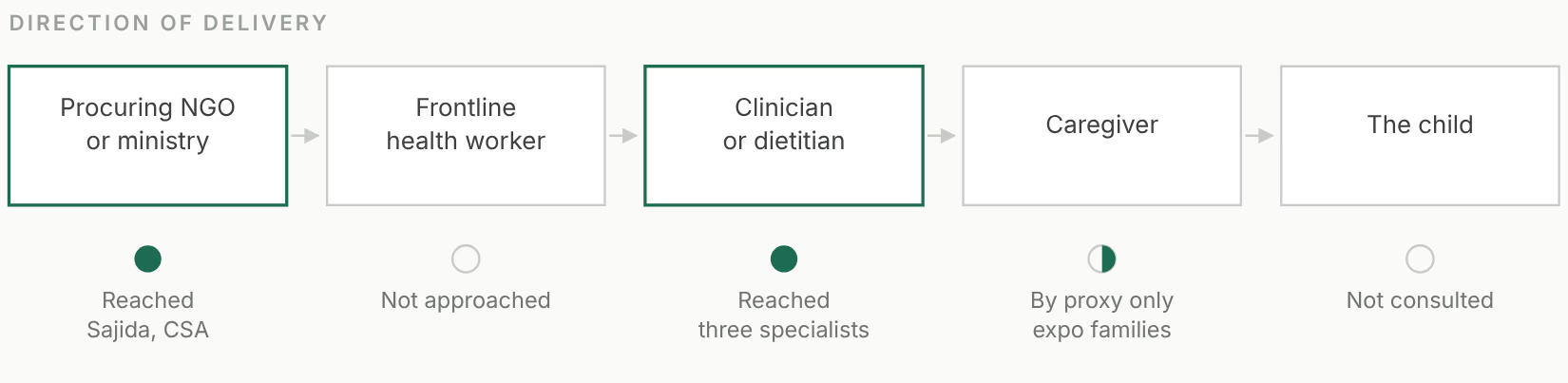
It is tempting to say our end user is a malnourished child. That is the beneficiary, not the user. A child does not decide to take a probiotic, does not obtain it, and does not administer it. If we design for the beneficiary and ignore the chain of people who have to agree before anything reaches them, we build something nobody can deliver.
| Who | Their role in the chain | What they need from us |
|---|---|---|
| The child | Beneficiary. Severe acute malnutrition, failing or at risk of failing an appetite test. | Something that works fast enough to matter, and does no harm while it does. |
| The caregiver | Decides whether the child receives it at all, and administers each dose. | A reason to trust a living organism given to an already sick child — and food worth being hungry for. |
| The frontline health worker | Runs the appetite test, decides home treatment or admission, dispenses. | A clear place in the existing protocol, and no new equipment. |
| The clinician or dietitian | Owns the nutrition plan and carries the clinical risk. | Evidence of safety, and an honest account of what the mechanism does not cover. |
| The procuring NGO or ministry | Buys, stores and distributes at scale, inside a government-approved setting. | Shelf stability, a cost per dose, and a regulatory status they can act on. |
Everyone with a stake, and where we stand with them
| Stakeholder | Stake | Status | Documented in |
|---|---|---|---|
| Dr. Nalini Raghunathan | Microbiome science and live biotherapeutics; our chassis and assay design | Consulted | Technical Expertise |
| Dr. Rajasree Nambron | Endocrinology; the appetite circuit our target sits inside | Consulted, recorded | Clinical Expertise |
| Ms. Gabriela Gardner | Clinical dietetics; barriers to eating and probiotic safety | Consulted, recorded | Clinical Expertise |
| Dr. Mayra Corona Moreno | Behavior analysis; why an individual child refuses a plate | Consulted, recorded | Clinical Expertise |
| Dr. Rajashekar G | Food availability, crop diversity and community trust | Consulted, recorded | Public Outreach |
| Dr. Robert L. Bender II | Geriatric medicine; appetite loss and failure to thrive in older adults | Consulted, recorded | Clinical Expertise |
| Dr. Sara Schutte | General pediatrics; undernutrition and feeding in children | Consulted, recorded | Clinical Expertise |
| Dr. Bharat Puchakayala | Gastroenterology; the gut compartment our organism acts in | Consulted, recorded | Clinical Expertise |
| Tamanna Ferdous | Public health delivery in a high-burden setting | Cited as expert consultant | Public Outreach |
| Families at the expo | Caregivers of children with sensory-driven food refusal | Engaged in person | Public Outreach |
| Students and public | Scientific literacy; future team members | Ongoing | Education |
| Donors and sponsors | Fund the work; require a plain-language account | Ongoing | Entrepreneurship |
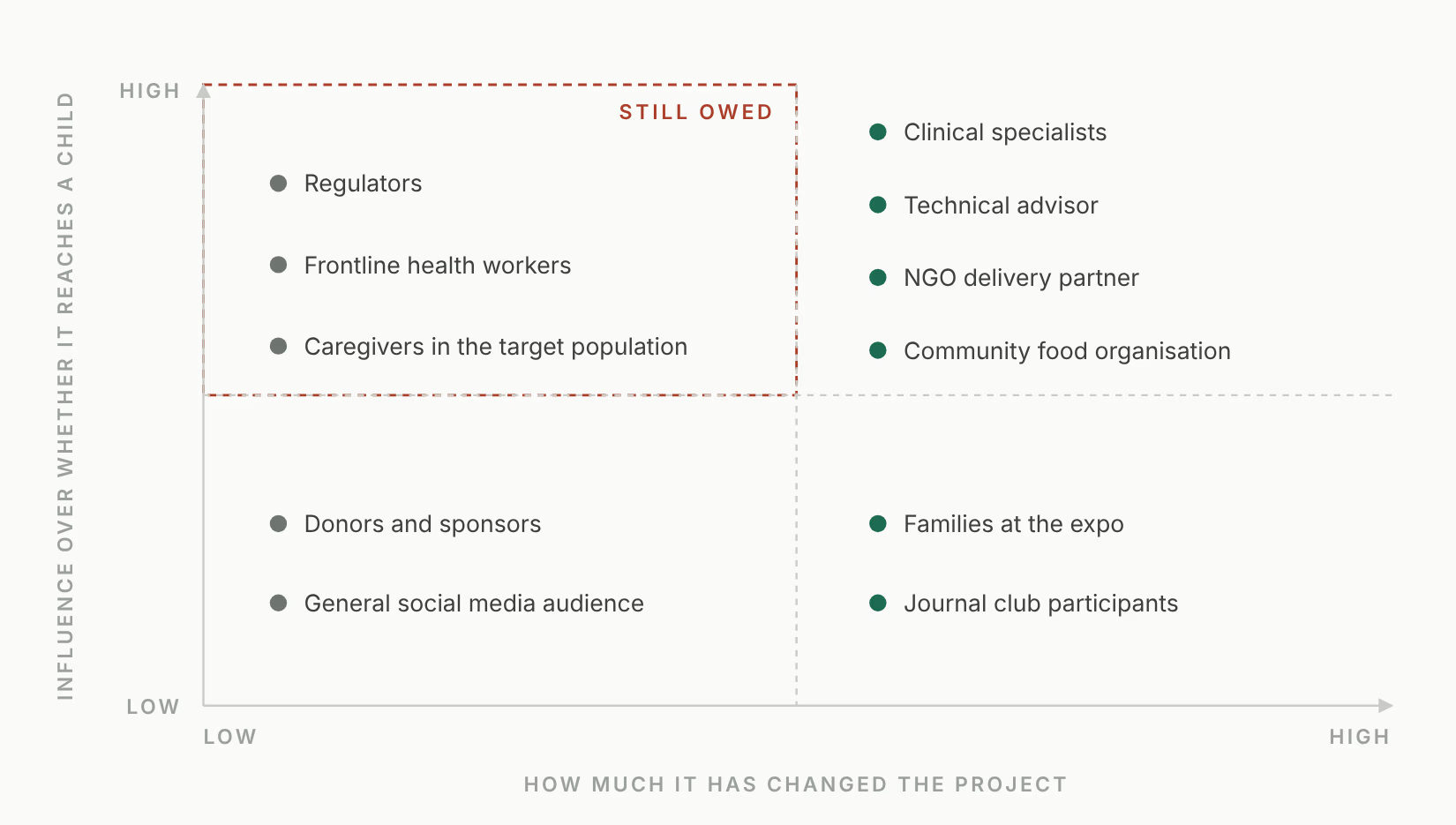
| Regulators | Decide whether a live engineered organism can be given to a child | Not approached | — |
| Frontline health workers | Would run the appetite test and dispense | Not approached | — |
Which conversations we still owe
We assessed each stakeholder group on two axes: how much influence they have over whether this project could ever reach a child, and how much our engagement with them has actually changed it. The gap between the two is the agenda for next year.
Conversation by conversation
This table is the test of whether any of the above counts as integrated. Every entry in the right-hand column points at something on another page of this wiki.
| Input | What we heard | What we changed |
|---|---|---|
| Dr. Corona Moreno 6 Jul | Seven causes of food refusal; appetite is one. The interventions that work are behavioral, not molecular. | Reframed the probiotic as one part of a spectrum of care. Built the $3 Meal Plan and took a booth at the expo. |
| Tamanna Ferdous 15 Jul | Comorbidities, hygiene, duration, cost, distribution. And: a hungrier child may just eat more cheap food. | Stopped calling it a solution. Implementation questions now part of how we describe it. Committed to a screening-tool project. |
| Expo families 26 Jul | Affordable and sensory-acceptable are two different requirements. | Sensory acceptability made a separate evaluation axis. Dropped the broad public description of the project. |
| Ms. Gardner 12 Sep | Twelve barriers to eating. Probiotics are withheld in ICU for translocation risk. BMI was never built to diagnose an individual. | Added an exclusion criterion for active infection or barrier compromise. Repositioned to the recovery phase. Dropped BMI as an outcome measure. |
| Dr. Rajashekar G 20 Sep | Loss of crop diversity and food access drive malnutrition. Nutrient gardens raised vegetable consumption threefold. | Project described as working alongside food-access approaches. Independence and locally built trust added as design principles. |
| Dr. Raghunathan 3 Oct | Spatial mismatch, host redundancy, no kinetic evidence for our enzyme choice. Commercial kits measure the wrong thing. | Assay moved to LC-MS/MS OEA depletion, with BSA carrier, no-enzyme control and a catalytic-dead mutant as the load-bearing control. |
| Dr. Nambron 4 Oct | Appetite is a redundant, defended loop. Hedonic pathways override fullness. Gut hormones peak 15–20 minutes in. | Narrowed the claim to lowering one satiety signal. Endpoint stays at OEA hydrolysis, not feeding behavior. |
| Dr. Schutte 16 Oct | In children, eating is not always appetite. Refeeding after bowel rest is the rate-limiting step. Cyproheptadine already works, and sedates. | Added hyperphagia syndromes to the exclusion criteria. Added a short-term inpatient indication. Named cyproheptadine as the comparator we have to beat. |
| Dr. Bender 17 Oct | OEA is not uniform across malnourished patients; the level moves with the underlying illness. Traditional appetite stimulants fail in older adults. Isolation outweighs much of the medicine. | Baseline OEA stated as something to be characterized rather than assumed. Recorded advanced dementia with failure to thrive as an adjacent indication. |
| Dr. Puchakayala 18 Oct | OEA rises immediately on refeeding. The chassis and the mechanism read as novel to a gastroenterologist. Mouse models are the next step. | Endpoint timing added to the Measurement question: when OEA is read, not only what. Nothing else, the rest of the session was an endorsement. |
The striking thing about that table is how much of it agrees with itself. Five people who have never met, working in behavior analysis in Texas, clinical dietetics in Houston, general pediatrics in Iowa, public health in Bangladesh and sustainable agriculture in India, told us the same thing in five different vocabularies: appetite is one item on a list, and the items above it are usually more important.
We did not plan that convergence, and we could not have manufactured it. It is the reason we are confident the change it produced is real rather than politeness. A single expert telling a student team their premise is too narrow is an opinion. Five independent experts say it is a finding.
The project did not get bigger because of Human Practices. It got smaller, and true.
Two changes matter more than the rest, and both came from questions we did not think to ask. Ms. Gardner mentioned in passing that clinicians withhold probiotics in intensive care because of translocation risk, not knowing our chassis is a live organism destined for a gut that malnutrition has already made permeable. That single remark produced our exclusion criterion and moved the whole intervention from the acute phase to the recovery phase. Dr. Raghunathan pointed out that host enterocytes already express FAAH, which is the kind of fact that is obvious once said and invisible until somebody says it. Neither appeared on any list of questions we had prepared.
We would change one thing about how we did this. Our first expert conversation, with Dr. Corona Moreno on 6 July, shaped everything public we built. The other eight landed in September and October, after the meal plan and the expo were finished. That worked, but it worked on the strength of one well-chosen early conversation rather than by design. The recommendation we would pass to next year’s team is to front-load the expert sessions, write the Questions down before each one.