
Engagement · Entrepreneurship
Entrepreneurship & Implementation
A realistic proposed path to real-world use: who would use it, and the hurdles.
OREXA is an engineered live biotherapeutic candidate for geriatric anorexia, the persistent loss of appetite in older adults. It affects a large share of long-term care residents, and the drugs currently available for it are the ones geriatric prescribing guidelines tell clinicians to avoid.
Scope and positioning
OREXA’s lead indication is geriatric anorexia in supervised care settings: long-term care facilities, post-acute rehabilitation, and hospital nutrition services. Everything on this page is sized and argued for that indication.
We narrowed to it deliberately, from an earlier framing that led with pediatric malnutrition. Three reasons:
- Consent and monitoring. Residents in supervised care consent for themselves or through established surrogate processes, and intake, weight and adverse events are already recorded daily. A first-in-human study of a live engineered organism needs that density of observation.
- A readable endpoint. Appetite and energy intake in long-term care have validated instruments and a standard comparator. Pediatric growth outcomes take far longer to read out and confound with many other variables.
- A conventional regulatory entry point. Adult studies in a supervised setting are the normal route for a novel live biotherapeutic. Pediatric studies follow adult safety data; they do not precede it.
Pediatric malnutrition is out of scope for this entry
It appears nowhere in our market sizing, business model or roadmap. Deliberately modulating appetite signaling in children raises consent, growth and neurodevelopmental questions that a first-in-class engineered organism should not carry as its first indication, and we would not pursue it without adult safety data and a dedicated ethics review.Problem and unmet need
Poor appetite is close to the norm in long-term care, and the drugs used to treat it are the ones geriatric guidelines tell clinicians to avoid. That gap, a high-prevalence condition with no recommended pharmacological option, is the opening we are building into.
Prevalence. A systematic review of anorexia of aging cites prevalence ranging from up to 25% in community-dwelling older adults, to 62% in hospital populations, to 85% in nursing home populations (Cox et al., Nutrients, 2019). Even taking the low end of the long-term care range, the condition is routine rather than exceptional in the setting we are targeting.
Why it matters clinically. Sustained low intake in older adults drives weight loss, loss of muscle mass, impaired wound healing and slower recovery from acute illness. The appetite deficit is the upstream barrier: supplying better food does not help a resident who stops eating after a few bites.
Why current drugs are not the answer. The two most-used appetite stimulants are both on the list of medications to avoid in older adults:
- Megestrol acetate produces minimal gains in appetite and weight and no improvement in quality of life or survival, while carrying increased risk of thrombotic events, fluid retention and death. One estimate is that roughly 1 in 12 patients gains weight while roughly 1 in 23 has an adverse event leading to death (AAFP Choosing Wisely rationale).
- Megestrol and cyproheptadine are both listed in the AGS Beers Criteria as medications to avoid in older adults (same source).
- The Nutrients review found only megestrol had been tested in two double-blind placebo-controlled trials, with mixed and unreplicated results, and concluded that the findings “caution against the use of these medications” and that medication is “an unattractive option” given side-effect profiles and polypharmacy (Cox et al., 2019).
The unmet need, stated precisely. There is no appetite intervention for older adults in supervised care that is both supported by controlled evidence and compatible with geriatric prescribing guidance. High-calorie oral supplements raise weight but, per the Choosing Wisely rationale, have no demonstrated effect on quality of life, mood, function or survival. The need is for an intervention that acts without the systemic exposure that drives the current safety objections.
Customer discovery
We interviewed clinicians, nursing and dietetic staff, caregivers and NGO program staff. Every design constraint below traces to something an interviewee said, not to something we assumed.
Method. Semi-structured interviews, 20 to 40 minutes, with an open prompt (“walk me through the last resident or patient you cared for who would not eat”) followed by probes on current practice, what they had tried, and what would make them adopt something new. We coded responses for recurring pain points and stopped adding new segments once themes repeated rather than diverged.
| Segment | Why we spoke to them | What we heard |
|---|---|---|
| Geriatricians | Prescribing decision-makers for appetite complaints | Will not prescribe megestrol or cyproheptadine in this population; want a mechanism-based option without systemic exposure |
| Long-term care nursing and dietetic staff | Day-to-day users; control what actually reaches a resident | Already run fortified-food and supplement protocols; a new item must fit an existing med or meal pass without new training |
| Caregivers and family | Buy and administer at home; drive adherence | Prefer non-pharmaceutical options; describe supplement “shake fatigue” and refusal |
| Older adults themselves | The end user; adherence lives or dies here | Struggle with swallowing pills, already on many medications; a food-format or sachet product is more acceptable |
| NGO and global health program staff | Possible route to lower-resource settings | Need low cost, shelf stability without cold chain, and simple dosing |
From insight to design requirement. Each interview theme produced a specific, testable product requirement:
| Interview theme | Design requirement it produced | How we will know we met it |
|---|---|---|
| Systemic side effects are the reason clinicians refuse current drugs | Activity confined to the gut lumen; no meaningful systemic exposure of the expressed enzyme | Biodistribution and systemic exposure assays in preclinical models |
| Pill burden and swallowing difficulty | Sachet or food-matrix format, not a tablet or capsule | Palatability and acceptability testing in the target age group |
| Must fit existing care workflows | Once-daily, room-temperature, no reconstitution step | Stability data at ambient storage; time-and-motion check with nursing staff |
| Cost and cold chain are the barriers in lower-resource settings | Lyophilized, shelf-stable formulation | Accelerated stability study at the target storage condition |
| Caregivers prefer something that reads as food, not medicine | Food-grade chassis and a familiar delivery format | Caregiver preference testing against a capsule comparator |
Where discovery is still thin
We have not yet interviewed the people who actually decide purchasing: long-term care medical directors, pharmacy and therapeutics committees, and group purchasing organizations. For a product sold into facilities, these are the real buyers, and clinician enthusiasm does not substitute for their sign-off. Closing this gap is the highest-value remaining discovery work.Technology and approach
The candidate is a live biotherapeutic: a food-grade bacterial chassis engineered to express a hydrolase that acts on lipid-derived signaling molecules in the gut lumen. The intended effect is local attenuation of a satiety signal, rather than systemic action on central appetite pathways.
| Component | Function | Design rationale |
|---|---|---|
| Chassis strain | Colonizes or transits the gut; carries the expression construct | Food-grade organism with established use, to lower the characterization and safety burden |
| Expression construct | Produces the hydrolase in the gut lumen | Enzyme acts on its substrate locally, so activity does not require systemic absorption |
| Expression control | Limits when and how much enzyme is produced | Constrains activity to the intended site and reduces the chance of unbounded effect |
| Formulation | Lyophilized sachet or food matrix | Came directly from discovery: ambient storage, no reconstitution, no pill burden |
Why local action is the core claim. Every documented objection to the existing drugs, sedation with cyproheptadine, thrombotic risk and adrenal suppression with megestrol, follows from systemic exposure. A product whose active component works in the lumen and is not meaningfully absorbed is targeting exactly the failure mode that keeps the current options off the recommended list. This is the claim the whole business case rests on, and it is therefore the claim that needs the strongest data. We do not yet have it; see Development status.
What we are not claiming
We are not claiming demonstrated efficacy in humans, a known effect size, or that local action has been shown rather than designed for. We are also not claiming the mechanism is fully predictable: modifying a signaling pathway that regulates intake could plausibly overshoot, and dose-finding and a defined off-ramp are design requirements rather than afterthoughts. Containment and expression-control requirements are listed under Risks.Competitive landscape
No approved product targets satiety signaling for geriatric anorexia. The competition is a set of options that are either guideline-discouraged, unsupported by outcome data, or aimed at a different part of the problem.
| Option | Mechanism | Evidence and documented limitation |
|---|---|---|
| Megestrol acetate | Progestational appetite stimulant | Minimal appetite and weight gain, no quality-of-life or survival benefit; thrombotic events, fluid retention, hyperglycemia, adrenal suppression. On the AGS Beers list to avoid in older adults (AAFP; Cox et al., 2019) |
| Cyproheptadine | Antihistamine appetite stimulant | On the AGS Beers list to avoid in older adults; sedation and anticholinergic burden in a population already exposed to both (AAFP) |
| Mirtazapine | Antidepressant with appetite side effect | Likely to raise appetite or weight when treating depression, but little evidence for use for appetite or weight in people without depression (AAFP) |
| Oral nutritional supplements | Added calories and protein | Raise weight, but no demonstrated effect on quality of life, mood, function or survival; does not address low intake itself (AAFP) |
| Cannabinoids, anabolic steroids, omega-3s, thalidomide | Various | Reviews found no adequate evidence of efficacy and safety for weight gain (AAFP) |
| Conventional probiotics | General gut health | Not formulated or indicated for appetite or intake; no satiety-pathway activity |
Where this leaves us. Our differentiation is not that we work better, because we have no comparative data and cannot claim that. It is that we are attempting a mechanism with a plausible route to acceptability in a population where the pharmacological options are actively discouraged. That is a real but narrower claim than “first-in-class appetite modulator,” and it is the one we can defend.
The competitor we should take most seriously
Not another drug: it is non-pharmacological care. Mealtime assistance, feeding support, dining-environment changes and treating reversible causes such as oral pain, medication side effects and depression are what guidelines actually recommend, and they are free of regulatory risk. Any clinician we sell to will reasonably ask why they should add a live engineered organism before exhausting those. Our answer has to be that we address residents in whom reversible causes have already been addressed and intake remains low, which also defines the trial population.Market sizing
Our serviceable obtainable market in US long-term care is roughly $12M a year at a realistic early penetration, built up from facility and resident counts rather than down from a global market figure.
We have deliberately dropped the “1% of a $61B market” style of estimate. A share-of-a-large-number figure is not a serviceable market, and iGEM judges and investors both discount it. The build below can be checked line by line and argued with.
| Step | Value | Where it comes from |
|---|---|---|
| US nursing homes | 14,700 facilities | CDC NCHS FastStats, 2022 |
| US nursing home residents | 1.2 million | CDC NCHS FastStats, 2022 |
| Share with clinically significant poor appetite | 30% (conservative) | Published range for long-term care runs to 85% (Cox et al., 2019); we use well under the low end |
| Residents in whom reversible causes have been addressed and intake remains low | 60% of the above | Our assumption, not sourced. See the flagged assumptions below |
| Addressable residents | ~216,000 | 1.2M x 0.30 x 0.60 |
| Annual revenue per treated resident | $550 | $1.50 per day, priced between a daily oral supplement and a branded medical food |
| SAM (US long-term care) | ~$119M per year | 216,000 x $550 |
| SOM at 10% of SAM | ~$12M per year | Realistic three-year post-launch penetration for a new entrant selling into facilities |
TAM, stated honestly as a ceiling. If every older adult with clinically significant poor appetite across US long-term care, post-acute and community settings were treated at this price, the US opportunity is in the low billions. We present this only as an upper bound, not as a number we expect to approach. For external context, the global oral clinical nutrition market was valued at $32.2B in 2024 and is forecast to reach $54B by 2034, a 5.5% CAGR (Global Market Insights). This is the adjacent category we would sell alongside, not a market we would capture.
Expansion layers, in the order we would pursue them.
- US post-acute and rehabilitation: same buyer, same monitoring density, shorter stays.
- Hospital nutrition services: higher prevalence (62% in hospital populations) but short length of stay limits a course-based product.
- Community-dwelling older adults: largest population, hardest to reach, lowest monitoring; a later-stage market needing a different channel.
- Lower-resource settings through NGO programs: the humanitarian case, but requires a cost structure we have not yet modeled.
The three assumptions most likely to be challenged
We flag these rather than bury them:
- The 60% “reversible causes addressed” figure is our estimate with no source behind it. It is the single weakest number on this page. A chart review in a partner facility would replace it with a real one.
- The $1.50 per day price is unvalidated. We have not tested willingness to pay with any facility, pharmacy committee or payer. Long-term care operates on thin margins and per-resident-day budgets, so this needs testing before it carries any weight.
- 10% penetration in three years assumes a reimbursement route we do not yet have. Without a billing pathway, adoption depends on facilities paying out of operating budget, which would push penetration well below 10%.
Business model
We sell a course-based product to facilities, priced per resident-day, with licensing as the secondary route. A direct-to-caregiver subscription is a later-stage option, not a launch model.
| Element | Our model | Why |
|---|---|---|
| Primary customer | Long-term care and post-acute facilities and their pharmacy suppliers | Concentrated buyers, existing distribution, monitoring already in place |
| Unit of sale | Daily sachet, sold as a 30-day course | Matches med-pass workflow; course framing suits a therapeutic rather than a supplement |
| Pricing | ~$1.50 per resident-day, to be validated | Sits between a daily oral supplement and a branded medical food |
| Channel | Long-term care pharmacy distributors and group purchasing organizations | How products actually reach these facilities; direct sales do not scale here |
| Secondary revenue | Strain and formulation licensing to nutrition and medical-food companies | Lets a partner carry commercial scale-up while we keep the platform |
| Later-stage | Direct-to-caregiver subscription for community use | Needs a consumer brand, adherence support and a different regulatory posture |
Cost structure. Fermentation and lyophilization; encapsulation or matrix formulation; release testing and strain identity confirmation per lot; stability program; cold-chain-free distribution; and, the item most early business cases omit, the regulatory and quality system required for a live biotherapeutic, which dominates spend until launch.
Unit economics, not yet modeled. We do not have a cost of goods estimate. For a lyophilized live biotherapeutic, cost per dose is driven by fermentation yield, lyophilization cycle time and per-lot release testing, and at $1.50 per day the margin question is real rather than rhetorical. A first-pass COGS model is on the roadmap and should be in place before any investor conversation.
Why not sell as a probiotic supplement
It would be faster and cheaper, and we considered it. We rejected it: the FDA guidance is explicit that an IND is required where a product is studied for its ability to treat or mitigate disease, even when marketed as a food or dietary supplement (FDA, Early Clinical Trials with Live Biotherapeutic Products). Selling an engineered organism for a clinical indication under a supplement label would be both non-compliant and, for a live modified strain in frail older adults, indefensible.Regulatory pathway
OREXA is a live biotherapeutic product regulated as a biologic by FDA’s Center for Biologics Evaluation and Research, and it requires an IND before any clinical study. Being a genetically modified strain adds requirements on top of the standard LBP package. This is a multi-year path, and the original “regulatory submission in Year 3” framing understated it substantially.
All requirements below are from FDA’s guidance on Early Clinical Trials with Live Biotherapeutic Products.
The IND is not optional. An IND is required where a study tests whether a product can diagnose, cure, mitigate, treat or prevent disease, explicitly including products otherwise marketed as foods or dietary supplements.
| Area | What FDA expects |
|---|---|
| Strain identity | Name, origin, culture history, genetic and phenotypic traits; identification to species and strain level by at least two complementary methods |
| Antibiotic susceptibility | Testing with actual laboratory data submitted, not pass/fail summaries |
| Manufacturing | Named manufacturer, process description, flow charts, in-process controls |
| Specifications | Identity, potency (usually CFU), purity, microbial contamination; limits on non-product bacteria and fungi for oral products |
| Drug product | Composition, manufacturing, release testing, labeling, stability protocol, with additional stability requirements for lyophilized products |
| Environmental | A categorical exclusion or an environmental assessment; an assessment is likely for organisms that are virulent or ecologically fit |
| Nonclinical safety | Animal and/or in vitro studies of the clinical formulation covering general toxicity, target organs, and teratogenic, carcinogenic and mutagenic potential, plus dose and duration relationships |
The engineered-strain surcharge. The guidance does not specifically address recombinant LBPs and states that such products are likely to raise additional considerations, with sponsors encouraged to contact FDA before submitting an IND. For a modified strain, the IND must document the modifications and the genetic construction, justify any antibiotic resistance genes, explain how attenuation was achieved and shown to be stable, and assess whether resistance could transfer to other microbes. For OREXA this means genetic stability over passage and in vivo, a containment or clearance strategy, and horizontal gene transfer assessment are IND-enabling work, not optional extras.
One consequence for our trial design. FDA notes that early studies in healthy volunteers can help identify common adverse events before testing in more vulnerable groups. Our target population, frail older adults in long-term care, is precisely such a group. We should expect to run a healthy-adult safety study first, which adds a phase our original roadmap did not contain.
Immediate regulatory action
Request a pre-IND meeting with CBER before committing to the nonclinical package. The guidance explicitly recommends consulting CBER, ideally at a pre-IND meeting, on what nonclinical data are needed. For a recombinant LBP this meeting shapes the entire program, and running the studies first risks doing the wrong ones.Honest timeline. From current status to first-in-human is realistically three to five years, with IND-enabling work dominating. Nothing on our roadmap should imply commercial launch inside three years.
IP strategy
We have identified three candidate components and drafted a provisional patent outline covering composition of matter, method of use and manufacturing process. No application has been filed.
| Component | Claim type | What it would need to be patentable |
|---|---|---|
| Engineered strain expressing the hydrolase | Composition of matter | Novelty over prior engineered strains expressing the same or similar enzyme class; the chassis and construct combination must not be obvious |
| Expression control circuit | Composition / method | A specific, non-obvious control architecture; a generic inducible promoter is unlikely to clear obviousness |
| Delivery formulation for gut-localized activity | Composition / method | Specific formulation parameters with data showing they deliver a result a skilled formulator would not expect |
Freedom to operate is the open question. We have not run an FTO search. Enzyme-expressing engineered probiotics are an active field with substantial existing patent coverage, and the hydrolase class we are using is well characterized, which cuts both ways: easy to work with, harder to claim. An FTO search should precede any further patent spend, because discovering blocking art after filing is the expensive order to do this in.
Sequencing. Provisional filing is the cheap option that preserves a priority date for twelve months, but a provisional is only as good as the data supporting it. Filing before we have expression and stability data risks a priority date we cannot convert. Our order is: FTO search, then generate the supporting data, then file the provisional.
For iGEM specifically
Our parts, construct designs and characterization data go to the Registry under the competition’s open-science terms. The patent strategy covers the formulated product and the manufacturing process rather than the Registry parts themselves, and we state this split explicitly so the open-science and commercial positions do not appear to conflict.Development status and evidence quality
We have two prototype iterations and preliminary in vitro work. We have no efficacy data and no animal safety data. Stating this plainly is deliberate: overstated preliminary results are the fastest way to lose a judging panel’s confidence.
| Item | Status | What the evidence actually supports |
|---|---|---|
| Prototype v1 | Enzyme expression confirmed in vitro | The construct expresses. It does not show activity on the target substrate in a gut environment |
| Prototype v2 | Improved expression and stability | Relative improvement over v1 under our assay conditions. Not a shelf-stability claim |
| Cytotoxicity screen | No cytotoxicity observed in a preliminary cell-based assay | The strain was not acutely toxic to cells in one assay. This is the weakest tier of safety evidence and does not support any general safety claim |
| Efficacy | None | No in vivo intake or appetite data exists |
| Genetic stability | Not assessed | Required for the IND; not started |
| Containment / clearance | Not assessed | Required for the IND; not started |
On the cytotoxicity result. Our earlier draft said “no cytotoxicity observed in preliminary assays” in a position that read as a safety claim. In vitro cytotoxicity screening says nothing about colonization behavior, immune response, genetic stability in vivo, or effects in frail older adults. We have moved it into the evidence table above so the claim sits at the strength the data supports.
Stakeholder traction, described accurately. Clinicians have expressed interest in pilot testing, care centers have asked about early access, and NGO contacts have discussed field feasibility. These are expressions of interest in conversation, not letters of intent, signed agreements or commitments of any kind. They indicate the problem is real and recognized; they are not commercial validation. Converting two or three into written letters of support, which cost a partner nothing and demonstrate genuine engagement, would materially strengthen this section.
The honest summary
We have a plausible mechanism, a well-characterized problem, a clear regulatory path and early construct-level data. We do not have evidence that the approach works. The next twelve months should be about generating that evidence, not about commercial scale-up.Roadmap
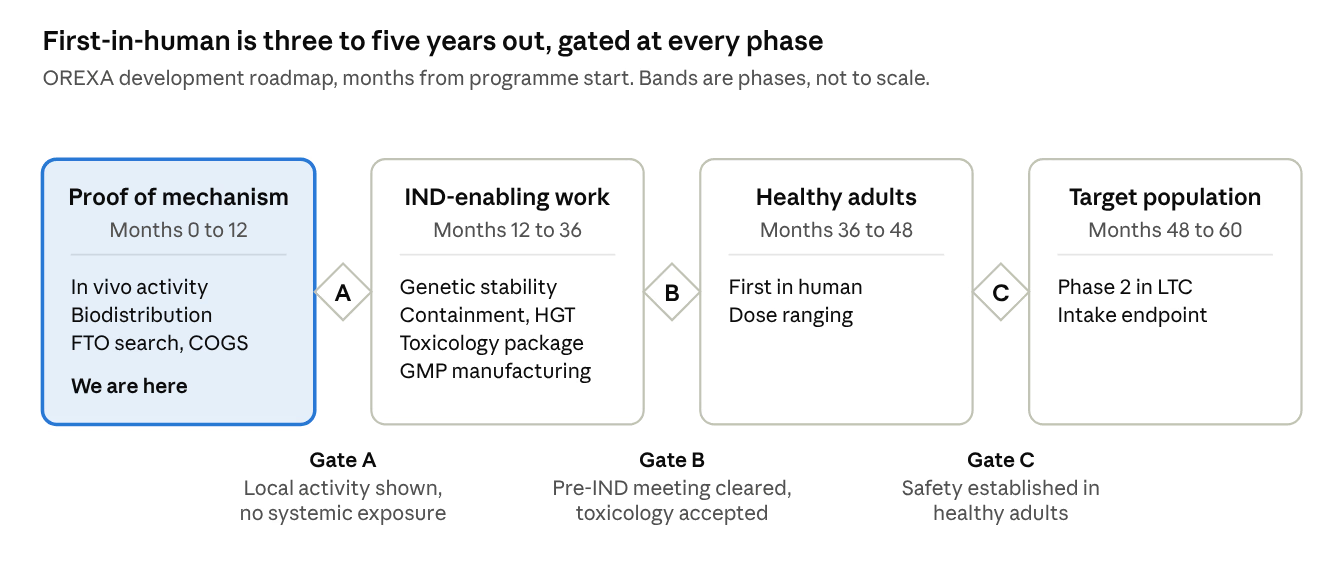
Each gate is a stop condition, not a milestone to celebrate: failing Gate A means the local-action claim is wrong and the program should stop rather than proceed. The original Year 1 to Year 3 plan put commercial launch where Gate B now sits, which is roughly two years and one clinical phase optimistic.
Risks and open questions
| Risk | Why it matters | What would resolve it |
|---|---|---|
| Local action is designed for, not demonstrated | The entire differentiation claim rests on it | Biodistribution and systemic exposure study in an animal model |
| Effect size unknown, and overshoot is possible | Modifying an intake-regulating signal could push intake past the intended range | Dose-ranging in vivo, with a defined stopping rule and a route to clear the strain |
| Genetic stability and containment unassessed | IND-blocking, and the principal public-acceptance question for an engineered organism | Passage stability studies, horizontal gene transfer assessment, containment strategy |
| Trial population is frail and vulnerable | Older adults in long-term care are a protected population; FDA points to healthy-volunteer work first | Healthy-adult safety study ahead of the target population; ethics review at protocol design |
| No reimbursement pathway identified | Determines whether penetration is 10% or 1% | Payer and long-term care pharmacy interviews; coverage analysis |
| COGS unmodeled at a $1.50/day price | Margin may not exist at the assumed price | First-pass cost of goods model from fermentation and lyophilization estimates |
| No freedom-to-operate search | Blocking art could invalidate the IP strategy after filing spend | FTO search before further patent work |
| Purchasing decision-makers not interviewed | Clinician interest does not equal a sale in facility purchasing | Interviews with medical directors, P&T committees and GPOs |
Public acceptance, which we should not treat as a communications problem. A live genetically modified organism administered to frail older adults will attract scrutiny, and some of it will be legitimate. Our position should be that containment, genetic stability and reversibility are engineering requirements we meet before any clinical work, not messaging to be managed afterwards.
The question we expect from judges
“Why should a facility give a resident an engineered organism rather than mealtime assistance and treating reversible causes?” Our answer defines the trial population: residents in whom those steps have already been taken and intake remains low. We should be able to say how many residents that is in a real facility, and at present we cannot.Sources
Pages opened for the figures and claims on this page.
References
- Cox NJ, et al. Assessment and Treatment of the Anorexia of Aging: A Systematic Review. Nutrients. 2019;11(1):144. doi:10.3390/nu11010144
- American Academy of Family Physicians. Choosing Wisely rationale on appetite stimulants and high-calorie supplements in older adults. https://www.aafp.org/pubs/afp/issues/2014/0215/p247.html
- US Food and Drug Administration. Guidance for Industry: Early Clinical Trials with Live Biotherapeutic Products, Chemistry, Manufacturing, and Control Information. https://www.fda.gov/regulatory-information/search-fda-guidance-documents/early-clinical-trials-live-biotherapeutic-products-chemistry-manufacturing-and-control-information
- Centers for Disease Control and Prevention, National Center for Health Statistics. FastStats: Nursing Home Care. https://www.cdc.gov/nchs/fastats/nursing-home-care.htm
- Global Market Insights. Oral Clinical Nutrition Market. https://www.gminsights.com/industry-analysis/oral-clinical-nutrition-market
Figures carried over from an earlier business case without a source, the $61B global malnutrition market, $14B pediatric nutrition, $21B geriatric nutrition and $73B probiotics figures, have been removed rather than cited, because we could not verify them.
The science behind the mechanism is on our Project Description page, and the conversations that shaped the clinical positioning are on our Clinical Expertise page.