
Engagement · Overview
Engagement Overview
Where the project started, what six experts told us, and the four things their answers changed.
We are building a probiotic that makes malnourished children hungry. This page is the record of eight people showing us why that sentence needed rewriting.
Our strain is E. coli Nissle 1917, engineered to express FAAH, an enzyme from F. prausnitzii that breaks down oleoylethanolamide (OEA), one of the signals the gut uses to say it has had enough. If we could switch the hunger back on, we thought, the food would do the rest.
Standing commitment
A written summary of our open questions, returned to Sajida Foundation for review.
A number, and an assumption underneath it
UNICEF counts 144 million children under five who are stunted and 47 million who are wasted. Many of them will not eat even when food is in front of them. Appetite loss is so central to severe acute malnutrition that it has been built into the clinical pathway itself: the appetite test is what decides whether a child is treated at home or admitted to inpatient care.
Our design followed from that directly. Find the signal that suppresses appetite, express an enzyme that degrades it, and put that enzyme inside an organism that already lives where the signal is made. Each step was tractable, and for several months we treated the tractability of the biology as evidence that the idea was sound.
What we had not examined was the assumption sitting underneath all of it, which is that appetite is the thing standing between a malnourished child and a meal. Our Human Practices work is the record of eight people taking that assumption apart, and of what we changed once they had.
Appetite was one item on everybody’s list
We approached specialists in each field our project touches, and deliberately also two organizations working where malnutrition is actually concentrated rather than where it is studied. None of them told us to stop. All of them told us the problem was wider than our description of it.
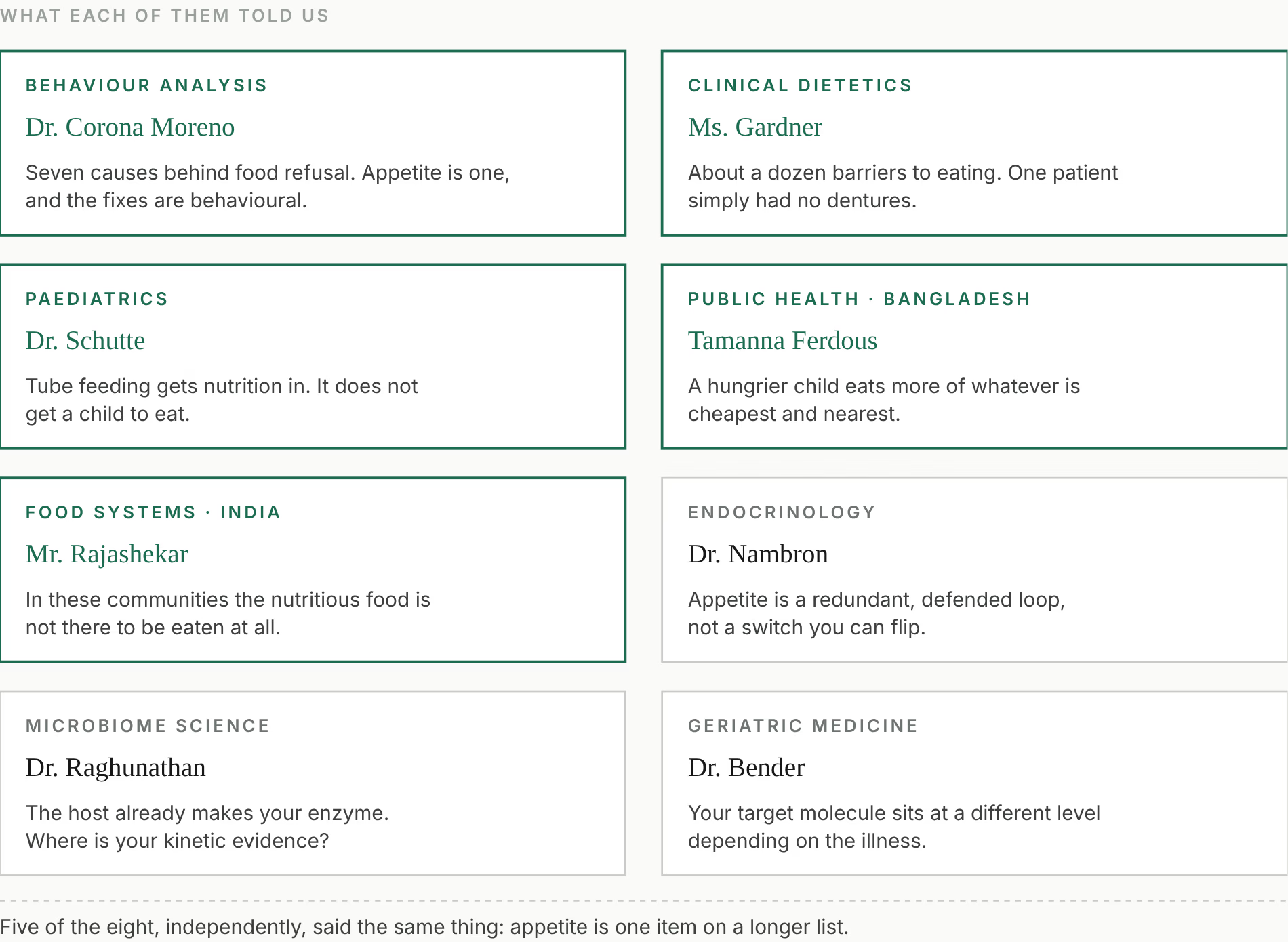
In their own terms: a behavior analyst gave us seven reasons children refuse food, and appetite was one. A dietitian gave us about a dozen barriers that stop a patient from eating, including one patient who had no dentures and could not chew. An endocrinologist showed us how many signals set appetite at once. A microbiome scientist asked for kinetic evidence we did not have and noted that the gut already makes our enzyme itself. A public health specialist in Bangladesh asked what a hungrier child eats when the cheapest food nearby is chips and sugary drinks. A food systems organization in India told us that in the communities it serves, the nutritious food is not there in the first place. A pediatrician of thirty-five years told us that tube feeding gets nutrition into a child but does not make the child eat. And a geriatrician told us that the molecule we target sits at different levels depending on which illness caused the malnutrition.
We did not plan that convergence
We did not plan that convergence, and we could not have manufactured it.
One expert telling a student team their premise is too narrow is an opinion, and it is the kind of opinion a team can absorb politely and then ignore. Five of them, independently, working in different disciplines on two continents, with no knowledge of what the others had said, is a finding. It is the single most useful result our Human Practices work produced, and everything on the Integrated Human Practices page follows from it.
The project got smaller, and true
None of this stopped the work. It changed four specific things: what we claim the probiotic does, where in a treatment pathway it belongs, which children it must exclude, and how we intend to measure whether it works. Each one is traceable to a named conversation.
| What changed | What it was before | What it is now | Who moved it |
|---|---|---|---|
| The claim | A treatment for appetite loss in malnutrition | One tool addressing one barrier out of roughly twelve | Ms. Gardner, Ms. Ferdous |
| The phase | Given during acute severe malnutrition | Repositioned to the recovery phase | Ms. Gardner |
| The exclusions | None defined | Excludes active severe infection, suspected intestinal barrier compromise, and hyperphagia syndromes | Ms. Gardner, Dr. Schutte |
| The endpoint | Feeding behavior, with BMI as outcome measure | OEA depletion by LC-MS/MS; BMI dropped for functional measures | Dr. Nambron, Dr. Raghunathan, Ms. Gardner |
| The assay | Commercial hydrolase activity kit | LC-MS/MS substrate depletion, BSA carrier, catalytic-dead control | Dr. Raghunathan |
| The baseline | Assumed uniform across malnourished patients | Characterized per indication, because OEA varies with the cause of the malnutrition | Dr. Bender |
| The indications | Severe acute malnutrition in children only | Adds advanced dementia, and short-course refeeding after bowel rest | Bender, Schutte |
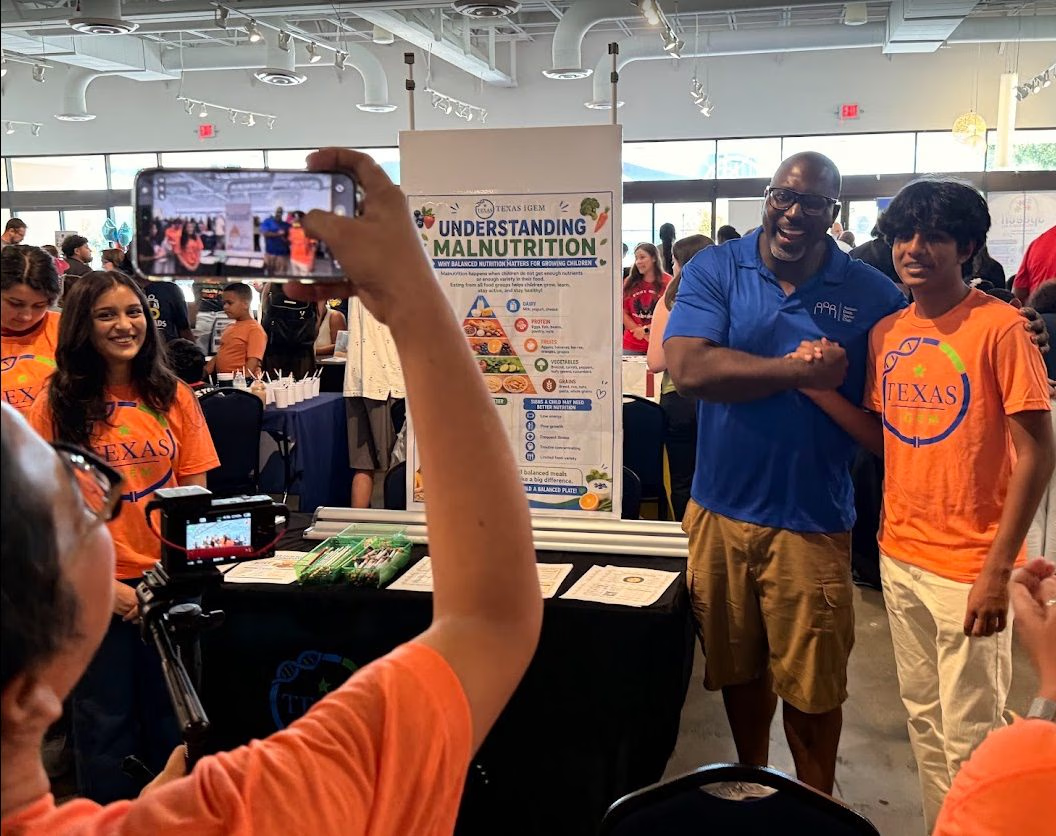
Alongside those changes we built something we could deliver immediately. The $3 Meal Plan is a set of more than thirty balanced recipes costing under three dollars a serving, documented on QR-coded notecards linking to videos of students cooking them, and handed out at a back-to-school autism expo in Houston. It exists because a behavior analyst told us, in our very first expert session, that the help those families needed was not something our science could provide.
What we have not done
We have not spoken to a regulator. We have not reached a frontline health worker who runs the appetite test and decides whether a child goes home or is admitted. And we have not spoken to a caregiver of a severely malnourished child in the communities our project describes. The families we met at the expo are caregivers, but of autistic children in Houston, which is a different population with different reasons for refusing food. We are describing them as a proxy because that is what they are.
Four months, in the order it happened

| When | What happened |
|---|---|
| 3 Jul | Outreach team convened. Journal club and public engagement scoped. |
| 6 Jul | Dr. Mayra Corona Moreno, behavior analyst. Seven reasons a child refuses food; appetite is one. |
| 7 Jul | $3 Meal Plan began, directly out of that session. |
| 12 Jul | First donation received through Zeffy. Fundraising moves from planning to operating. |
| 15 Jul | Tamanna Ferdous, Sajida Foundation. The laundry list of questions we had never asked ourselves. |
| 18 Jul | Journal Club 01. Microbial production of psilocybin antidepressants through engineered non-natural biosynthetic pathways. |
| 26 Jul | Back to School Autism Resource Exposition, Houston. Booth, nutrition charts, QR-coded recipe cards. |
| 29 Aug | Journal Club 02. Engineering the gut microbiome to improve child growth and nutrition. |
| 12 Sep | Ms. Gabriela Gardner, dietitian. Twelve barriers, a safety constraint, and the end of BMI as our outcome measure. |
| 20 Sep | Dr. Rajashekar G, Center for Sustainable Agriculture. Before appetite, there has to be food. |
| 3 Oct | Dr. Nalini Raghunathan, AIG Hospitals, Hyderabad. The hardest questions anyone asked us. |
| 4 Oct | Dr. Rajasree Nambron, endocrinologist. Gut–Brain Dialogue: Decoding Appetite and Satiety Pathways. |
| 16 Oct | Dr. Sara Schutte, retired general pediatrician, Iowa. Eating is not always appetite; the comparator we had never named. |
| 17 Oct | Dr. Robert L. Bender II, geriatrician, Des Moines. Our target molecule does not sit at one level. |
| 18 Oct | Dr. Bharat Puchakayala, Gastroenterologist, UT Physicians at UTHealth Houston. Our target molecule rises the moment refeeding begins. |
Three documents, kept separate on purpose
Our engagement work is split across three documents, and they are kept apart deliberately. Running them together would let us claim that a flyer changed science, or that a webinar fed a community, and neither is true. The eight conversations themselves, in full, are on the Integrated Human Practices page; the Education record is on the Education page; the Entrepreneurship record is on the Entrepreneurship page.
| Document | What it covers |
|---|---|
| Integrated Human Practices | The eight expert conversations and the public engagement that came out of them, in the order the wiki structure sets: technical expertise, then clinical expertise, then public engagement. Each engagement is recorded in the same four-field format — Question, Engagement, Finding, Consequence — so a reader can check our reasoning rather than take our word for it. |
| Education | Our journal club. Two sessions, virtual and open to anyone, built on reading primary literature line by line, including the research our own enzyme comes from. |
| Entrepreneurship | What it costs to run this team, how we fund it, and an account of the distance between a sequence-verified plasmid and a product, mapped against the six-domain framework Dr. Raghunathan gave us. |
The four-field record is worth explaining here, because it governs the whole of the Integrated Human Practices document. Early on we wrote meetings up as summaries, and the summaries were useless: they recorded that a conversation had been pleasant without recording what it did to the project. Every record is now forced into four fields, of which the last is the one that matters. A record whose Consequence reads “nothing yet” is an honest record. A record with no Consequence field at all is a thank-you note.