
Project · Description
Project Description
The problem of childhood undernutrition, the synthetic-biology idea, and why E. coli Nissle and FAAH.
A child who will not eat cannot recover. We are engineering a probiotic to clear the gut signal that says stop eating, so that appetite comes back.
Malnutrition is not only a food problem
Treatment improved enormously with ready-to-use therapeutic foods: energy-dense pastes needing no fridge, no clean water and no preparation. They work when the child eats them.
Many children with severe acute malnutrition will not. Appetite loss is so central that it is built into the clinical pathway.
Appetite is the gate. We are aiming at the children who fail that test.
The body already has a switch for this
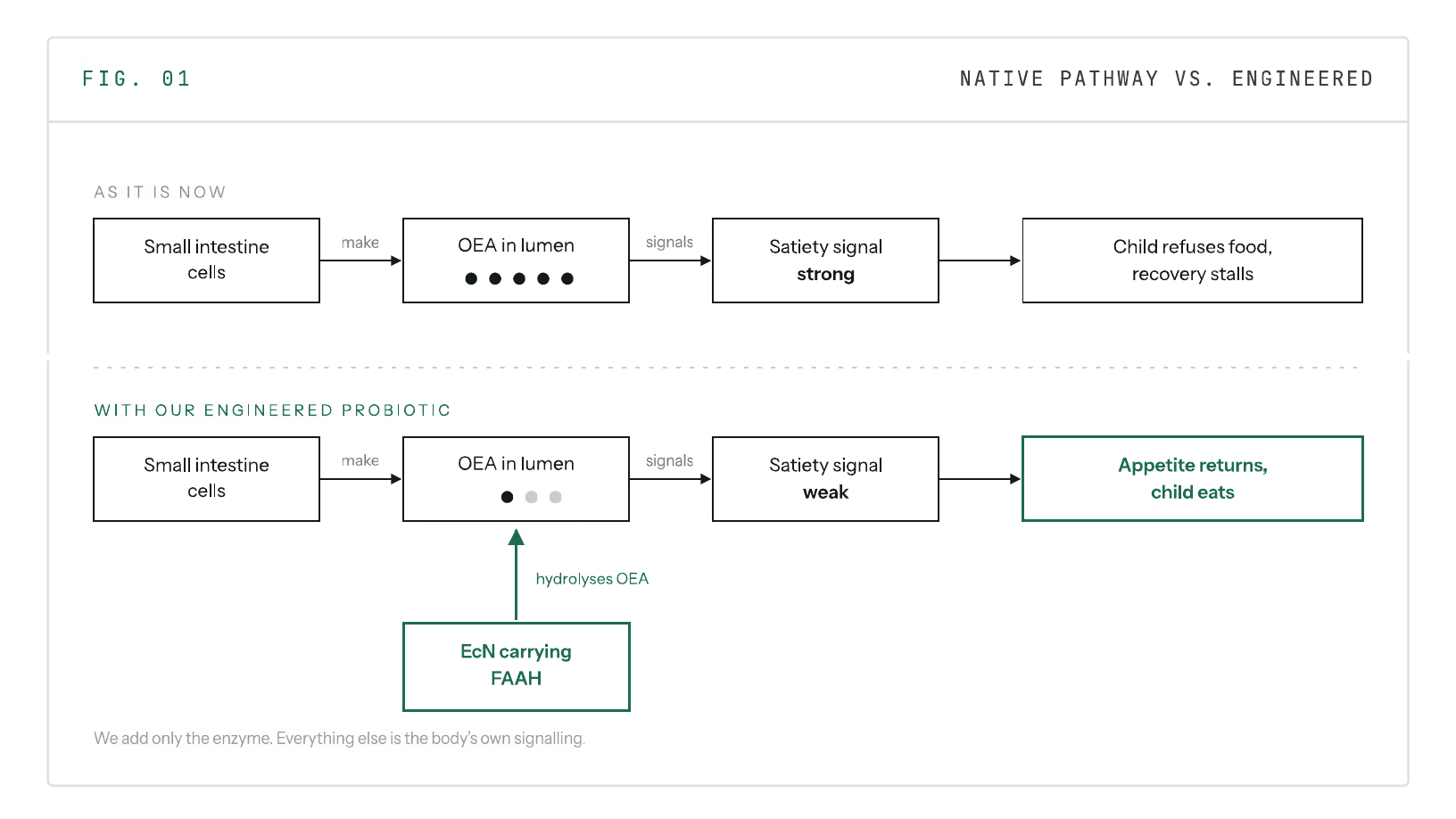
When food reaches the small intestine, its cells make oleoylethanolamide (OEA), a lipid signal that reduces food intake. Levels rise with feeding and fall with fasting.
OEA does not persist. Fatty acid amide hydrolase (FAAH), a serine hydrolase, breaks it down. How much satiety signal exists at any moment is a balance between the two rates.
More FAAH means less OEA, a weaker signal, and a child more willing to eat.
A living platform, not a pill
A drug needs purification, manufacturing, often a cold chain, and a correct dose given on schedule. Each of those fails most often where malnutrition is most common.
| Conventional drug | Engineered probiotic |
|---|---|
| Pharmaceutical synthesis and purification | Grown by bacterial culture |
| Often needs a cold chain | Lyophilised and shelf stable |
| Repeated dosing, caregiver dependent | Colonises and produces continuously |
| Must reach the gut from outside | Already where it needs to act |
OEA is made in the small intestine and acts there. A gut organism is already in the right place.
Take the gene from one, put it in another
Our chassis is E. coli Nissle 1917, and our enzyme comes from Faecalibacterium prausnitzii, one of the most abundant bacteria in a healthy gut.
Why EcN
- Already a probiotic — sold and licensed for over a century
- Survives the gut — passes gastric transit and colonises
- Non-pathogenic — Risk Group 1, handled at BSL-1
- Engineerable — standard cloning methods work
We cannot engineer F. prausnitzii. It is a strict anaerobe, difficult to culture, and has no established genetic toolkit.
The constraint that shaped the project
So we decoupled the two: take the enzyme from the organism that evolved it, and put it in the organism we can actually work with. That one decision is what makes this buildable by a student team.Making it is not the same as getting it there
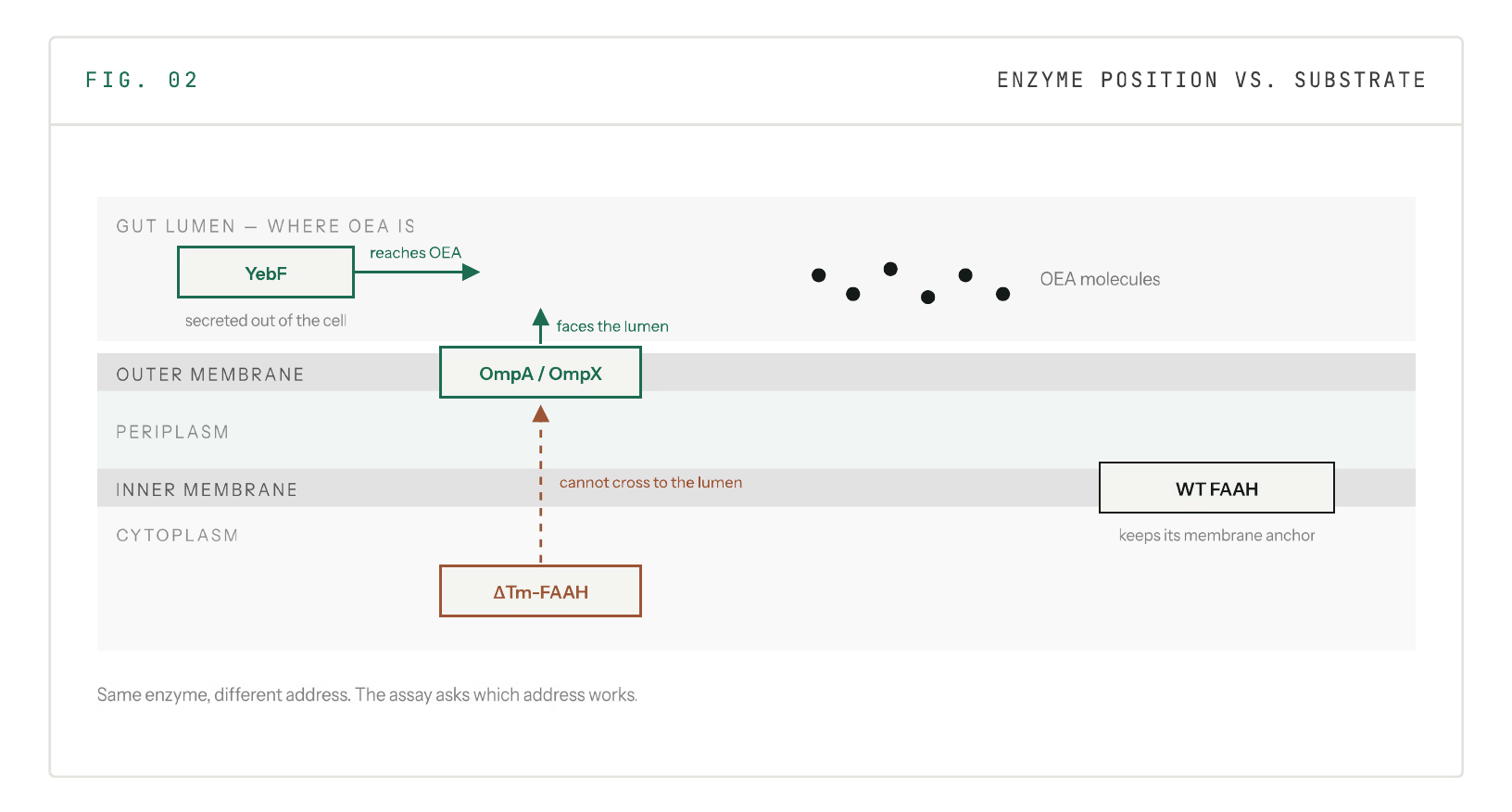
OEA sits in the gut lumen, outside the bacterium. An enzyme made in the cytoplasm is separated from its substrate by membranes it cannot cross.
Rather than guess, we built a panel that tests the question directly. Every variant is the same enzyme with the same 6xHis tag, differing only in where it is sent.
| Variant | Strategy | What it tests |
|---|---|---|
| 6xHis-WT-FAAH | Keeps its transmembrane sequence | Membrane-associated reference |
| 6xHis-ΔTm-FAAH | Transmembrane domain deleted | Does losing the anchor free it |
| 6xHis-YebF-ΔTm-FAAH | YebF secretion carrier | Can it be exported |
| 6xHis-OmpX-ΔTm-FAAH | OmpX signal peptide | Outer membrane display |
| 6xHis-OmpA-ΔTm-FAAH | OmpA signal peptide | Display, second route |
| 6xHis-GFP | Fluorescent expression reporter | Expression and backbone control |
| Catalytic mutant | Dead active site | Is the activity really FAAH |
Six of these have designed primers; the catalytic mutant does not, which is why it appears as Not built on the Results page. Because backbone and insert amplify in separate reactions, six constructs meant twelve PCR reactions. Both numbers appear in our notebook and they describe different things.
The last two are controls, and they are why the panel is interpretable. The GFP reporter confirms inducible expression in the backbone independently of whether the enzyme works. The catalytic mutant separates FAAH activity from anything the host does.
In vivo assembly cloning
We use IVA cloning, which lets E. coli join DNA fragments that share overlapping ends. Backbone and insert are amplified separately, the template is destroyed with DpnI, and both fragments are co-transformed. The cell does the joining.
No restriction enzymes, no ligase, no assembly mix. A new construct costs two primers, which is what let us iterate on a student budget.
Our backbone, pEM106.2, supplies an inducible promoter, chloramphenicol selection and a secretion carrier already in place. Clones are screened by restriction digest and confirmed by Sanger sequencing.
Where we actually are
What we have not shown
We have not shown that the enzyme is active, that it degrades OEA, or that it changes appetite in anything. The distance between a verified plasmid and a treatment is very large, and we would rather say so.The figure-by-figure evidence is on our Results page, the dated record on the Notebook page, and the assay designed to test the central claim on the Measurement page.
References
References
- UNICEF, WHO, World Bank Group. Levels and trends in child malnutrition: UNICEF / WHO / World Bank Group Joint Child Malnutrition Estimates, key findings of the 2020 edition. Geneva: World Health Organization; 2020. https://www.who.int/publications/i/item/9789240003576
- World Health Organization. Guideline: updates on the management of severe acute malnutrition in infants and children. Geneva: World Health Organization; 2013. https://www.who.int/publications/i/item/9789241506328
- Rodríguez de Fonseca F, Navarro M, Gómez R, et al. An anorexic lipid mediator regulated by feeding. Nature. 2001;414(6860):209-212. doi:10.1038/35102582
- Patricelli MP, Lovato MA, Cravatt BF. Chemical and mutagenic investigations of fatty acid amide hydrolase: evidence for a family of serine hydrolases with distinct catalytic properties. Biochemistry. 1999;38(31):9804-9812. doi:10.1021/bi990637z
- Sonnenborn U. Escherichia coli strain Nissle 1917, from bench to bedside and back: history of a special Escherichia coli strain with probiotic properties. FEMS Microbiol Lett. 2016;363(19):fnw212. doi:10.1093/femsle/fnw212
- Sokol H, Pigneur B, Watterlot L, et al. Faecalibacterium prausnitzii is an anti-inflammatory commensal bacterium identified by gut microbiota analysis of Crohn disease patients. Proc Natl Acad Sci U S A. 2008;105(43):16731-16736. doi:10.1073/pnas.0804812105
- García-Nafría J, Watson JF, Greger IH. IVA cloning: a single-tube universal cloning system exploiting bacterial in vivo assembly. Scientific Reports. 2016;6:27459. doi:10.1038/srep27459