
Engagement · Education
Education
Our journal club: two open sessions reading one paper at a time, including the research our own enzyme comes from.
We developed Journal Club presentations to help students explore current research related to our project and better understand how scientific discoveries can be translated into real-world applications. Two sessions ran in 2026, both virtual and both open to anyone who wanted to attend.
The method is section by section through one paper, then open discussion. Session 02 was recorded; Session 01 was not. This page records what we read, who presented, how a session is actually produced, and what we got wrong.
A small group presents; everyone else interrupts
Our presentations covered research topics connected to biotechnology, nutrition, gut microbiology and human health. Each session, a group of student presenters walks the room through one published paper in order, abstract, methods, results, discussion, and then the floor opens. Nobody is expected to arrive having understood it. That is the point of doing it together, and it is why the format is a presentation followed by questions rather than a reading assignment.
Journal Club was important to our project because it encouraged us to look beyond our own research and understand the work of scientists developing new approaches to complex health problems. Preparing presentations required us to read and interpret scientific research, identify the most important findings, and communicate those findings in a way that other students could understand.
This helped us recognize that scientific communication is just as important as scientific discovery. A strong research idea has greater potential to create an impact when people can understand its purpose, evidence and possible applications, a lesson that transferred directly into how we rewrote our own project description for the fundraising video and for this wiki.
The presentations also created an opportunity for students with different interests and levels of scientific experience to learn from one another. By discussing topics ranging from gut bacteria and child nutrition to engineered microorganisms and potential antidepressant production, we connected individual research papers to broader questions about biotechnology and human health. Rather than simply reading research independently, presenting it to a group encouraged us to ask questions, explain unfamiliar concepts aloud, and consider how the findings could relate to our own Texas iGEM project.
We wanted the habit of reading methods closely, because that is where a result is won or lost.
Microbes as factories
Session 01
18 July 2026 · 6:00 – 7:00 PM CT · Virtual
Microbial production of psilocybin antidepressants through engineered non-natural biosynthetic pathways
Why this paper
It examines how University of Houston researchers are engineering microorganisms to produce promising antidepressant compounds through non-natural biosynthetic pathways, connecting biotechnology with future approaches to mental-health treatment and drug development. It is the same move we make with FAAH in E. coli Nissle, take a biosynthetic capability an organism does not have and install it, in a system far enough from our own that the engineering logic is easier to see than the biology. Reading a parallel project is a better way to learn pathway engineering than reading your own, because nobody in the room is defending it.
Presenters
Nikita Vijay, Shivansh Shukla, Raisha Chakrabarti, Arjun Popuri
Promotion
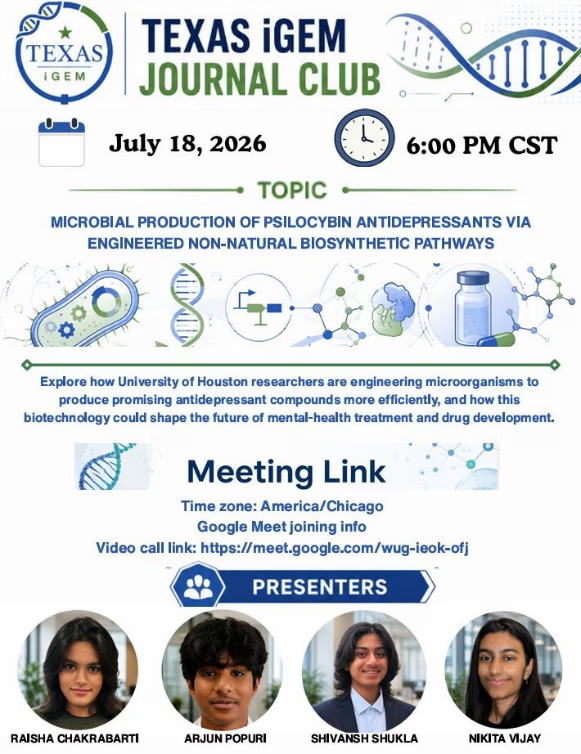
A student-designed flyer carrying the presentation topic, meeting time and virtual meeting information, posted to Instagram, Facebook and the team website.
Not recorded
No recording exists. Meeting recording sat behind a paid workspace tier we did not have, and we had not checked before the session began. This is the single clearest operational failure of the year and the reason the role split described below exists.
The organism our own enzyme comes from
Session 02
29 August 2026 · 5:00 PM CT · Virtual · Recorded
Why this paper
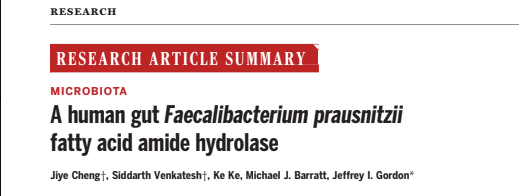
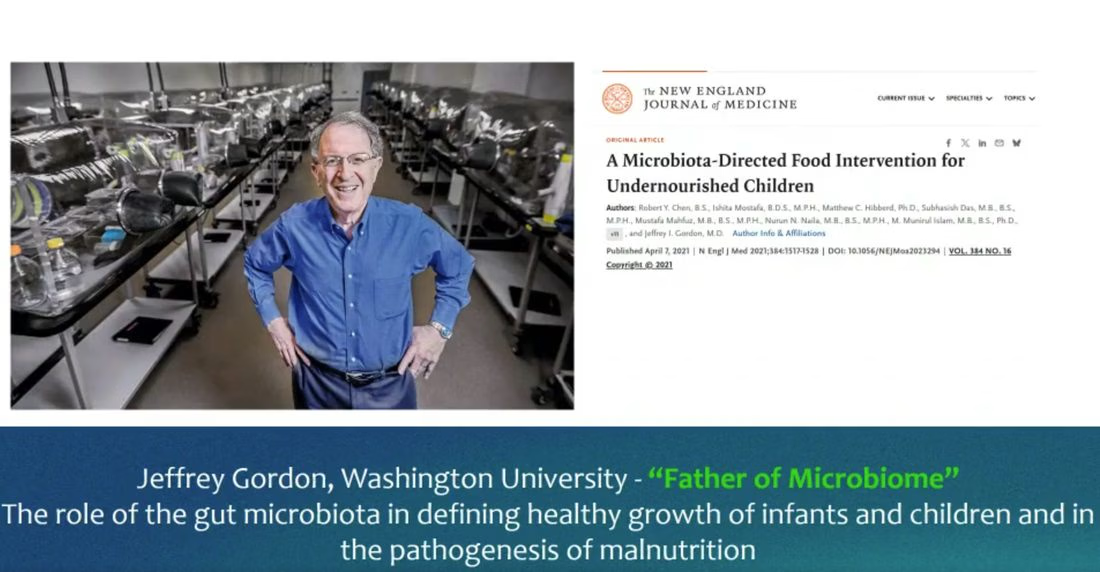
It explores how researchers are studying Faecalibacterium prausnitzii, a beneficial gut bacterium associated with growth, to understand how engineered microbes could improve nutrient use and restore disrupted gut functions in undernourished children. That is our project, stated as a research question by people who are not us. Reading it as a group meant the whole team, including members who never enter the lab, understood what our construct actually is and why we chose that organism as the source of the gene.
Presenters
Alyssa Janco, Ganeev Jaswal, Livsharan Puchakayala, Neel Heblikar
Recorded
Yes. The recording problem from Session 01 was solved by handing host controls to an account with recording rights, after a trial run on the morning of the session.
Promotion
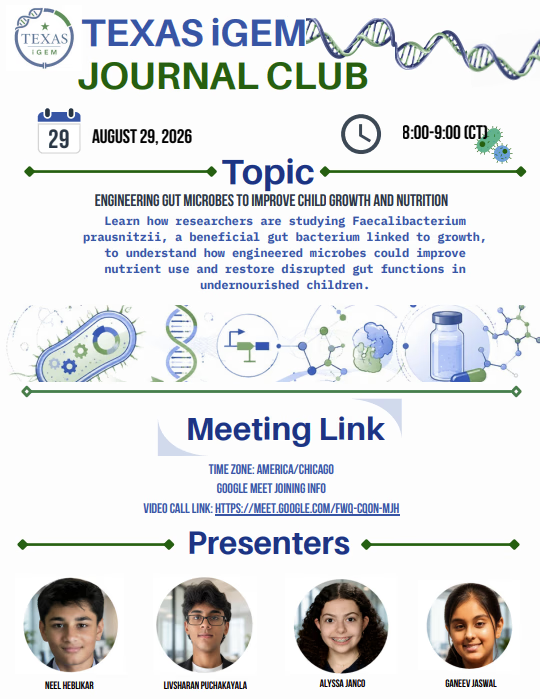
A student-designed flyer carrying the presentation topic, meeting time and virtual meeting information, posted to Instagram, Facebook and the team website was built as a reusable journal club template rather than a one-off.
How a session gets made
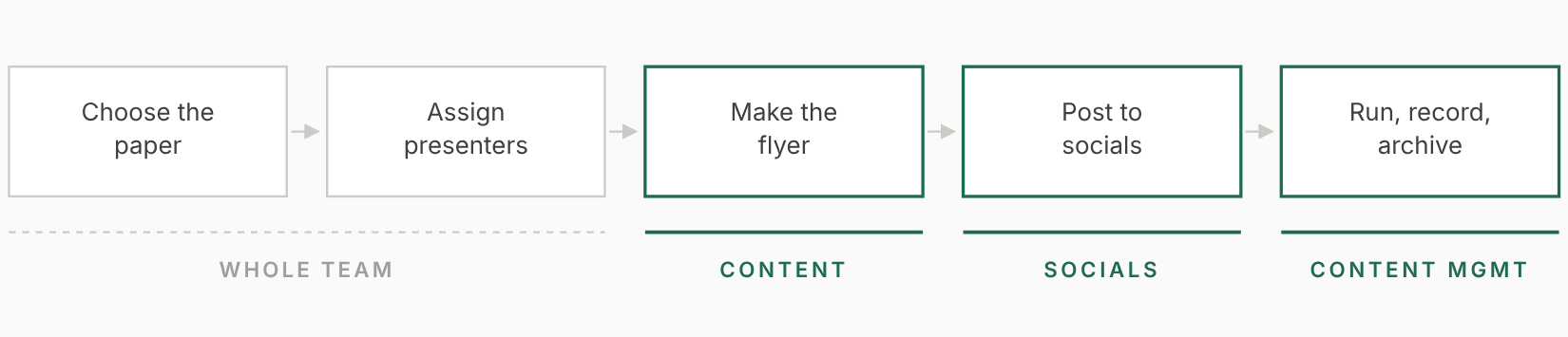
To make the Journal Club presentations accessible and consistent, we created informational flyers that included the presentation topic, meeting time and virtual meeting information. The flyers allowed students to understand the focus of each meeting before attending and provided a clear way to share the opportunity with others.
Running an open session is mostly logistics, and the logistics are where we improved most between July and August. The team ended up splitting into three standing roles rather than scrambling each time.
| Session 01 · ad hoc | Session 02 · three roles | |
|---|---|---|
| Flyer | Requested days ahead, briefed verbally | Content role owns flyer and session description |
| Presenters | Assigned, then reshuffled | Assigned once, rotated deliberately between sessions |
| Socials | Handled by whoever had the login | Socials role posts with proper titles, tags and links |
| Recording | No plan until the day; nothing captured | Content Management owns link, recording and archive |
| Template | Built from scratch | Reused from Session 02 onward |

Both flyers carried the presentation topic, the meeting time and the virtual meeting information, so students knew the focus before attending and could pass the invitation on. The second was built as a reusable template, which is why a third session will take an afternoon rather than a week.
What we got wrong
One limitation of our Journal Club was that scientific papers can be difficult for students to understand without prior experience reading research. To strengthen the presentations, our student presenters needed to focus not only on accurately representing the research but also on making complicated scientific ideas approachable. The first session leaned too far toward accuracy and lost part of the room; the second was better because the presenters had seen that happen.
This experience taught us to consider our audience when communicating science, and to explain research in a way that encourages questions rather than making the material feel inaccessible. It is the same lesson the expo taught the public engagement team in the same month, arrived at independently: the material you are proudest of is rarely the material that lands.
Overall, creating and presenting Journal Club presentations gave us experience interpreting scientific literature, communicating research, and connecting discoveries from different areas of biotechnology to real-world problems. It showed us that research is not only about generating new knowledge, but also about sharing that knowledge with others and creating opportunities for people to engage with science.